Our Shark PowerDetect Speed Plus vs Dyson V15 Detect guide compares a self-emptying Shark dock against Dyson’s lighter detect stick. In this guide, specs come from manufacturer pages and Amazon listings—not in-home lab testing. Therefore, see our comparison methodology and affiliate disclosure.
TL;DR
If you hate emptying the dustbin after every session and do not mind a heavier machine, the Shark PowerDetect Speed Plus is a practical workhorse with a self-emptying base, a 70-minute runtime, and peak suction of 380 W. If you want a lightweight stick you can carry up stairs without a second thought — and you can live with emptying it yourself — the Dyson V15 Detect Absolute at 6.83 lbs is the more maneuverable pick with a 4.5-hour charge turnaround.
Neither machine is perfect for every home. Read the full breakdown before you decide.
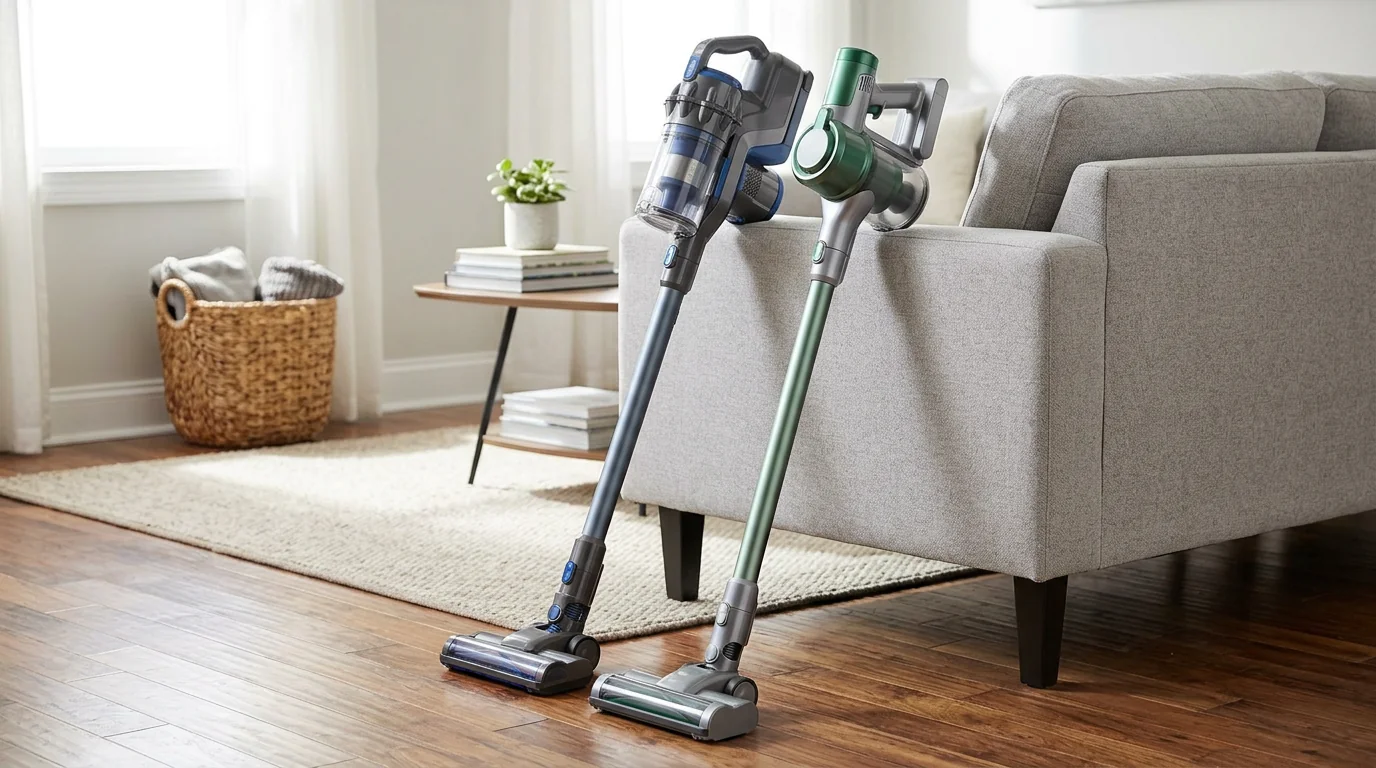
Editorial image: generic review scene only — not the actual product for sale.
Disclosure: This article may contain affiliate links. We may earn a commission if you buy through our links, at no extra cost to you. See our full affiliate disclosure.
How We Compare
This is a research-backed comparison using official manufacturer specification pages and Amazon retailer listings. We have not conducted hands-on or lab testing of either unit. All numbers in the table below are taken directly from the manufacturer sources cited in the Sources section. Where a spec was not listed in those official sources, we say so rather than fill in a guess. For independent performance testing, we recommend checking third-party review outlets on your own.
See our comparison methodology for more on how we source and vet data.
Specs at a Glance
| Spec | Shark PowerDetect Speed Plus | Dyson V15 Detect Absolute |
|---|---|---|
| Model number | IP3251 | V15 Detect |
| Weight | 18.47 lbs | 6.83 lbs |
| Peak suction power | 380 W (Boost mode) | 240 Air Watts |
| Max runtime | Up to 70 min | Up to 60 min |
| Dustbin capacity (handheld) | 0.7 qt | 0.77 L (0.2 gal) |
| Base / dock capacity | 2 L (self-empty base) | Not listed in official sources |
| Self-emptying base | Yes | No |
| Filtration | Pre-motor: Felt + Washable Foam; Post-motor: HEPA | 99.99% filtration down to 0.3 microns |
| Charge time | 6 hours | 4.5 hours |
| Dimensions (as listed by manufacturer) | 10.24″ L × 18.5″ W × 46.46″ H | 49.6 × 10.2 × 9.8 inches |
| Amazon listing | Check current price | Check current price |
Note: Shark lists dimensions as L × W × H; Dyson’s spec page does not label axes. Values are reproduced exactly as published by each manufacturer.
Pros and Cons
Shark PowerDetect Speed Plus
Pros
– Longest runtime in this comparison: up to 70 minutes before recharge
– Highest peak suction: 380 W in Boost mode
– 2 L self-emptying base keeps hands away from the dust
– Named HEPA filtration on the post-motor stage
Cons
– Heaviest machine here at 18.47 lbs — stairs and overhead cleaning are a real workout
– 6-hour charge time is the longer of the two
– The self-empty base ties the system to a fixed spot in your home
– Bulkier footprint makes apartment or small-space storage harder
Dyson V15 Detect Absolute
Pros
– Lightest option at 6.83 lbs — easy to carry between floors and overhead
– Faster charge at 4.5 hours
– 99.99% filtration down to 0.3 microns — strong for allergy-sensitive homes
– Compact form factor suits smaller living spaces
Cons
– Lower peak suction at 240 Air Watts vs 380 W
– Shorter max runtime: up to 60 minutes vs 70 minutes
– No self-emptying dock — you empty the 0.77 L bin yourself
– Bin volume (0.77 L) is relatively small; frequent emptying in larger homes is likely
Best For: Who Should Buy Which
Choose the Shark PowerDetect Speed Plus if:
- You have a large home (1,500+ sq ft) and want to vacuum top to bottom on a single charge
- You do not want to touch the dustbin — the self-empty base handles it for you
- Suction ceiling matters most: 380 W peak gives more headroom on thick carpet or pet-hair buildup
- You are not moving the vacuum frequently between floors or to a car
Choose the Dyson V15 Detect Absolute if:
- You live in an apartment, condo, or multi-story home where carrying the vacuum between levels is routine
- 18+ lbs is a dealbreaker — 6.83 lbs is dramatically easier for people with joint issues or smaller frames
- You want the vacuum charged and ready faster: 4.5 hours vs 6 hours
- Compact storage is a priority
Who Should Skip Each One
Skip the Shark PowerDetect Speed Plus if you live in a space under 800 sq ft, do not have a consistent spot for a docking base, or need to carry the vacuum up multiple flights of stairs regularly. At 18.47 lbs, it is not trivial to haul, and the 6-hour charge means an unplanned session could leave you waiting.
Skip the Dyson V15 Detect Absolute if you have heavy-traffic carpet, thick rugs, or significant pet-hair load and want maximum suction on demand. The 240 Air Watts versus 380 W gap is meaningful on dense flooring. The small bin also becomes a nuisance when cleaning large areas.
Buying Advice
The weight difference — 18.47 lbs vs 6.83 lbs — is the single biggest dividing line between these two machines, and it is not a small one. Think about how you actually move through your home: if you carry the vacuum between floors more than you push it around one level, the Dyson wins on ergonomics alone.
If you stay mostly on one floor and want the convenience of a self-emptying base, the Shark’s 2 L dock and 70-minute runtime make it a strong all-in-one solution. You trade portability for autonomy.
On filtration, both machines target allergy-sensitive users. The Dyson specifies 99.99% at 0.3 microns; the Shark names a post-motor HEPA stage. Both are solid manufacturer claims, though independent lab verification is worth checking through third-party sources before you finalize.
There is no single winner. The right choice depends on your floor plan, your physical comfort carrying equipment, and whether a self-emptying base fits your daily routine.
Frequently Asked Questions
Which has stronger suction, the Shark or the Dyson?
The Shark PowerDetect Speed Plus lists 380 W peak suction in Boost mode. The Dyson V15 Detect Absolute lists 240 Air Watts. The two manufacturers measure power differently, so a direct watt-for-watt comparison is an approximation — but the Shark’s peak figure is higher on paper.
Does the Dyson V15 Detect Absolute self-empty?
No. The Dyson requires manual bin emptying. Its bin holds 0.77 L. The Shark’s self-empty base holds 2 L.
How long does each take to charge?
The Shark takes up to 6 hours. The Dyson charges in approximately 4.5 hours.
Which is lighter?
The Dyson V15 Detect Absolute at 6.83 lbs is significantly lighter than the Shark PowerDetect Speed Plus at 18.47 lbs — a difference of nearly 12 lbs that becomes noticeable fast when carrying the machine between floors.
Which runtime is longer?
The Shark lists up to 70 minutes; the Dyson lists up to 60 minutes. Both are manufacturer claims under optimal conditions — actual runtime will vary with mode and surface type.
Are these good for pet hair?
Neither product page in our sources makes a specific pet-hair claim with tested numbers. Based on suction specs alone, the Shark’s higher peak wattage may help on dense carpet with pet hair. We recommend checking independent review sources for real-world pet-hair results.
Where can I buy these?
Both are available on Amazon:
– Shark PowerDetect Speed Plus: https://www.amazon.com/dp/B0GTC7X974?tag=realtestguide-20
– Dyson V15 Detect Absolute: https://www.amazon.com/dp/B0CH5QWSGK?tag=realtestguide-20
Related vacuum guides
- Shark PowerDetect Clean & Empty vs Dyson V15 Detect
- Dyson V8 Animal vs V8 Absolute
- How we compare products
Sources
- Shark PowerDetect Clean & Empty product page: https://www.sharkclean.com/products/shark-cordless-powerdetect-clean-empty-system-zidIP3251
- Dyson V15 Detect product page: https://www.dyson.com/vacuum-cleaners/cordless/v15/detect-yellow
- Amazon listing — Shark PowerDetect Speed Plus (B0GTC7X974): https://www.amazon.com/dp/B0GTC7X974?tag=realtestguide-20
- Amazon listing — Dyson V15 Detect Absolute (B0CH5QWSGK): https://www.amazon.com/dp/B0CH5QWSGK?tag=realtestguide-20
Last verified: May 30, 2026. Prices and availability subject to change.